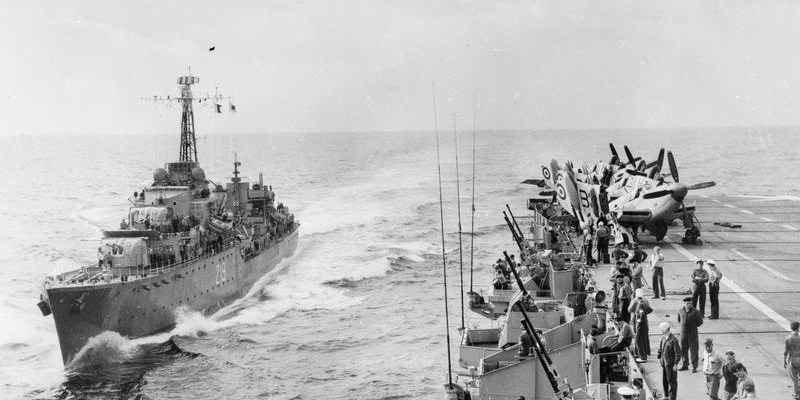
With much attention being devoted to multinational coalition operations, the Korean War (1950-1953) provides an interesting case study. Ian Bower has just published an edited volume devoted to this subject, to which I contributed a chapter on the Royal Navy.
When North Korea invaded South Korea in June 1950, the principal British contribution to the US-led response was naval forces, drawn from warships serving on the Far East Station. The Royal Navy theatre commander remained at the Station’s base in Singapore, while his subordinate, the ‘Flag Officer, second in command of Far East Station’ or FO2FE, acted as commander for operations off Korea. This British component served under an overall US Navy command but took under its wing most of the non-US warships contributed by coalition members. The British task group, which was given responsibility for operations off the west coast of the peninsula, routinely included Canadian, Australian, New Zealand, and Dutch warships, as well as some from the US and South Korean navies, and at times included French and Colombian escorts as well as Japanese minesweepers. The Royal Navy provided much of the logistic support for these allied navies as well as providing a task group structure which they could slot into. Commonwealth captains routinely took British warships under command just as US and British task force commanders did with warships from each other’s navies. For the Royal Navy the Korean War was therefore a case of simultaneously following and leading.
The relationship between Royal Navy commanders and their US superiors were, given the degree of coordination and even integration, remarkably smooth. There were a few causes of tension, however. Some were minor, such as a feeling among Royal Navy officers that when using naval gunfire against targets ashore, the US Navy was rather profligate with ammunition in its enthusiasm for ‘harassing fire’ rather than concentrating on identified targets; the captain of a British cruiser noted that it, ‘is almost as harassing to the donor as to the recipient’. The various clandestine organisations operated by the US services and the CIA off the west coast caused some exasperation. In particular, what one British officer referred to as the ‘funny parties’ were persistently reluctant to coordinate their activities with allied naval forces despite warnings that it would lead to friendly-fire incidents, an approach described as ‘self-immolating’. There were some examples of Britain and the US being divided by a common language; Rear Admiral Scott-Moncrieff noted that ‘available’ referred to maintenance in the USN but to operations in the RN, while, ‘“presently” to an American means “now”, to the British it means “later on”.’
The issue most singled out by successive FO2FE in their regular reports was a different culture of command. Minor gripes included a perceived penchant in the US Navy for long, excessively detailed signals (including, for example, long extracts from publications held by the recipient ships), which particularly strained the relatively limited communications capacity of Commonwealth ships. More fundamentally, successive FO2FE criticised the US Navy tendency to exercise command from at sea, rather than on land where coordination with allies and with the other services would be easier. This approach was seen as an unwelcome carryover from the wartime naval campaign in the central Pacific, which did not suit a joint campaign waged from close to bases. In contrast, the British system (resulting from wartime operations in the Home or Mediterranean theatres) saw command exercised from ashore. They also described the US command style as excessively rigid and centralised, allowing too little initiative to ship captains. The two issues were related: by generally locating himself ashore in Japan, in proximity to his superior naval commander, the British flag officer also allowed more discretion to lower-level commanders at sea – which was received well by US Navy captains when they came under Royal Navy command. One US commander of Task Force 95 (under which the British formed a task group) caused particular problems: ‘a great deal of “backseat driving” took place… any advice or question appeared to be regarded as criticism or unwillingness’. Even he loosened up with experience, however, and other US commanders were more accommodating. On the one hand, this experience does show that good relationships between commanders can do much to ease friction – yet as one FO2FE commented, ‘It is remarkable that so apparently rigid a system is so much at the mercy of personality.’ At one point, the vice-admiral attached to the British military mission in Washington suggested that these observations might be shared with the head of the US Navy, because honest criticism was healthy; the Royal Navy Far East commander vetoed this ‘dynamite’ suggestion due to the impact it could have on cooperation.
Some of the frictions of coalition integration were therefore resolved by pragmatic compromise between senior commanders, eased by recent experience of working together closely in the Pacific War and in postwar exercises. It also helped that US-British relationships were on a firm foundation both higher up, notably between the US Secretary of State and the British Ambassador to London, and also at the US Navy Far East Headquarters in Tokyo. Here, the naval adviser at the British Embassy offered his services and was made British liaison officer. He achieved a level of trust and access for the Royal Navy that was better than that of the other British services or its allies (for example, when the US Navy captured examples of the latest Soviet mines, they decided not share them with the French for fear of leaks but to ‘keep it in the family’ and share only with the British).
One example of the excellent cooperation that existed at lower levels between the British and the Americans was 41st Independent Commando Royal Marines. This unit was specially recruited in response to an explicit request from General MacArthur for Royal Marines to join the US raiding campaign. It benefitted from US training and equipment (though keeping the green beret) and conducted 18 landings before serving ashore alongside the US Marine Corps with the 1st Marine Division – which resulted in it being awarded a US Presidential Unit Citation. It operated from specialist shipping, including USS Perch, a submarine converted for special operations. Its commanding officer noted the impression that US Navy food made on British personnel, coming from a country where rationing was still in place: ‘One of our steaks is a week’s meat ration in England… One morning they averaged six eggs for breakfast.’ He also commented on how the two nationalities came together as a single force: ‘We have all been broadened by the experience and our language now carries the breath of Plymouth while the Royal Marines would be quite at home in San Diego.’ One example of potentially confusing language was revealed in the Royal Marines operation order for a landing on 1 October 1950, to blow up a railway tunnel and embankment: the designated password had the challenge ‘Tiddy’ with the reply ‘Oggie’. (For those unfamiliar with Cornish terminology, a ‘tiddy oggie’ is a highly satisfactory Cornish pasty.) US Navy sailors might have been educated in its meaning but it would no doubt have utterly baffled the North Korean soldiers who were encountered.
The British-led multi-national naval force that participated in the Korean War was a good example of coalition naval operations. The US Navy, the Royal Navy, and the Commonwealth navies all had considerable experience of working together closely during the Pacific campaign of the Second World War, and would – with several of the other partner navies from Korea – do so again in many subsequent operations both during and, in particular, after the end of the Cold War. One aspect with considerable contemporary relevance is the ability of the Royal Navy to act in a convening role, making it easier for other partner navies to contribute to a wider coalition effort, under overall US command.
Photograph:
© IWM A 32003: the Canadian destroyer HMCS Athabaskan comes alongside while escorting the Australian light fleet carrier HMAS Sydney, both serving as part of the British-led Western Task Group.
 Defence-In-Depth